
Why patients consider London
London can frame support and maintenance as part of a serious restoration plan, not just an upsell.
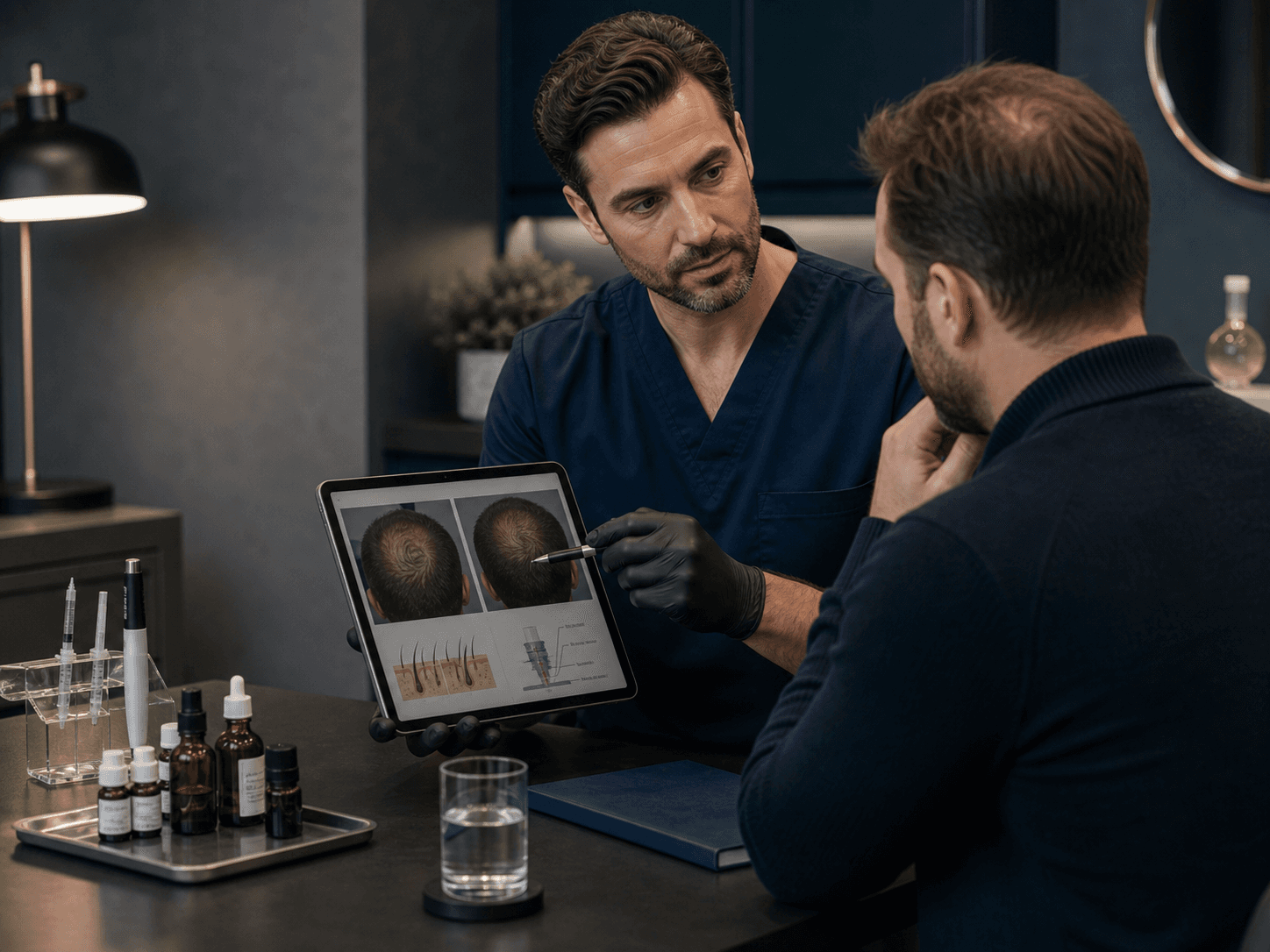
Non-Surgical Treatment Planning
Non-surgical planning depends on your thinning pattern, current shedding, maintenance goals, and whether treatment or surgery should come first.
Free consultation available for stabilisation, scalp support, and longer-term restoration planning.
Non-surgical support
Not every patient needs to move straight to surgery. Maintenance and non-surgical support still belong in a responsible restoration plan.
Best for
Early thinning, active shedding, scalp support, or long-term maintenance
Expected outcome
Improved hair-quality support and a clearer maintenance plan around restoration decisions
London context
Patients usually want London convenience, clear aftercare, and realistic planning to feel part of the overall care rather than added later.
Treatment overview
Non-surgical treatment helps make clear that active thinning support and transplant surgery are not the same decision.
It also helps patients who are still early in the decision, who are not yet ready for surgery, or who need a maintenance mindset before and after a procedure.
What the consultation should cover
Free consultation
A strong first consultation request includes case photos, your main concern, whether you want London only or may consider Turkey later, and what matters most to you: subtlety, density, recovery time, or cost clarity.
Why patients consider London
London can frame support and maintenance as part of a serious restoration plan, not just an upsell.
Why patients consider London
Patients often respond better to a more selective, informative approach than a transplant-only sales push.
Why patients consider London
Early assessment information and clinical standards help show how treatment choices are weighed.
Planning and execution
The best approach stays realistic and practical, with emphasis on support, stabilisation, scalp health, and longer-term planning rather than miracle-regrowth rhetoric.
This also sits alongside London treatment information and early assessment explanation because good restoration planning is not always surgery-first.
What to ask before booking
Recovery considerations
Free consultation
Send the details that matter most to your case: your concern, timing, any useful location context, and the kind of result you want to discuss.
What happens next
Prefer email? Write to hello@ukhairtransplant.co. You can also review our privacy policy.
Read next
Before You Enquire
See what to prepare before you enquire about treatment, including what information helps an initial assessment, what questions to ask, and what to review before deciding.
Our Clinical Standards
Understand the standards behind treatment recommendations, including GMC-registered doctors, CQC-registered providers in England, realistic planning, suitability, and aftercare.
Hair Transplant in London
Research hair transplant treatment in London with clear information on suitability, methods, pricing, aftercare, and the standards patients should check before moving forward.
Hair Transplant Cost in London
Understand hair transplant cost in London, what usually shapes the quote, what may be included, and what to compare before choosing treatment.
Frequently asked questions
Early thinning, active shedding, scalp support, or long-term maintenance. Suitability should still be confirmed after reviewing your current pattern, donor area, medical context, and long-term goals.
Ask who performs the procedure, how planning decisions are made, what aftercare is included, how realistic the quoted graft range is, and whether limitations are explained as clearly as benefits.
Assess whether surgery is the right step now or whether support and maintenance should come first. Discuss scalp health, thinning pattern, ongoing shedding, and treatment goals. Discuss how non-surgical options can fit into a wider hair-restoration plan.
Think in stages rather than one vague healing period. Recovery, aftercare, and the longer growth arc all matter if expectations are going to stay realistic.
Explore other treatments
Male Hair Transplant
Hairline, crown, and density restoration in London with careful planning and realistic long-term design.
Female Hair Transplant
Female hair transplant guidance in London with careful suitability checks, softer framing, and realistic density planning.
Eyebrow Transplant
Eyebrow transplant treatment in London focused on shape, angle control, and believable facial framing rather than blocky density.
Beard Transplant
Beard transplant treatment in London for patchy cheeks, outline definition, and stronger facial-hair structure with natural blending.
Moustache Transplant
Moustache transplant treatment in London for upper-lip definition, symmetry, and believable visible-area density.
Cookies and measurement
We use analytics and ad measurement cookies to understand which pages lead to assessments and to improve the site. You can accept analytics or continue with essential cookies only.